I’ve been discussing our velocity at length with my colleagues at work. We have
never been able to produce this much code in this little time. With a
subsidized coding subscription from one of the frontier labs, each jockeying for
technical hearts and minds, it’s never been a better time to be a software
developer. Being a software engineer, well, that’s becoming more challenging
for sure.
Since I first heard it, that line “software engineering is computer programming
integrated over time”
keeps reverberating between my ears. I’m vibe coding an entire Kubernetes-based
Linux distribution; how on earth can I keep this chaos under control? To me, the
answer is: MORE AI!
I feel like the liken family of projects is extremely high quality, but I don’t
deny that it is entirely vibe-coded. I have barely looked at the code myself,
even though there’s still a strong
instruction to treat the
repo as a “literate
programming” project with
extraordinary levels of code commentary inline for anything tricky. How can I
claim that the quality is high without having even seen the code? By scaling up
my quality control and product ownership with AI agents.
This code has been read in full at great levels of detail with adversarial
prompts. Sometimes I just get bored and ask Fable to go look for problems or
gaps or shortcomings. When I got access to
Astra today, the first thing I asked it
to do was find any security or reliability problems in liken proper and to
document them as open problems
(and
it
found
quite
a
lot
to
fix).
I continue to have the AI agents ratchet up code coverage and today we started
publishing code coverage reports on the documentation sites
(liken,
media,
audio,
bluetooth, and
display).
Meanwhile I test the product with an uncompromising eye. I will not let things
rest until every single part of it feels solid and reliable to me, and I can
test at a scale that matches the production of code. Building a system designed
as a love letter to Kubernetes implies a strong level of observability inherent
to the product. A lot of the in-cluster testing we do feeds back as new logging
or CRD .status fields that improve the legibility of the system. I’ve been
running liken as my homelab’s only operating system for months now and any
friction I hit I can feed directly back into LLMs to resolve it. Before the last
year or two, I would get too exhausted mentally to build and test and
product-manage my side projects, so it was very easy to make excuses to cut
corners. Now that I’ve scaled out testing and building, I can put all of my
energy into product-managing.
The commit history of the new library-operator tells this story well. It was a
twinkle in my eye in the last devlog, and now just 11 days later it feels better
to me than Jellyfin or Moonfin. In 2024, just the work
that went into
choosing
the iced UI toolkit alone would have been enough to make
me quit this side project by now. Now the fun part to me is actually the pixel
pushing and solving the hardest design questions.
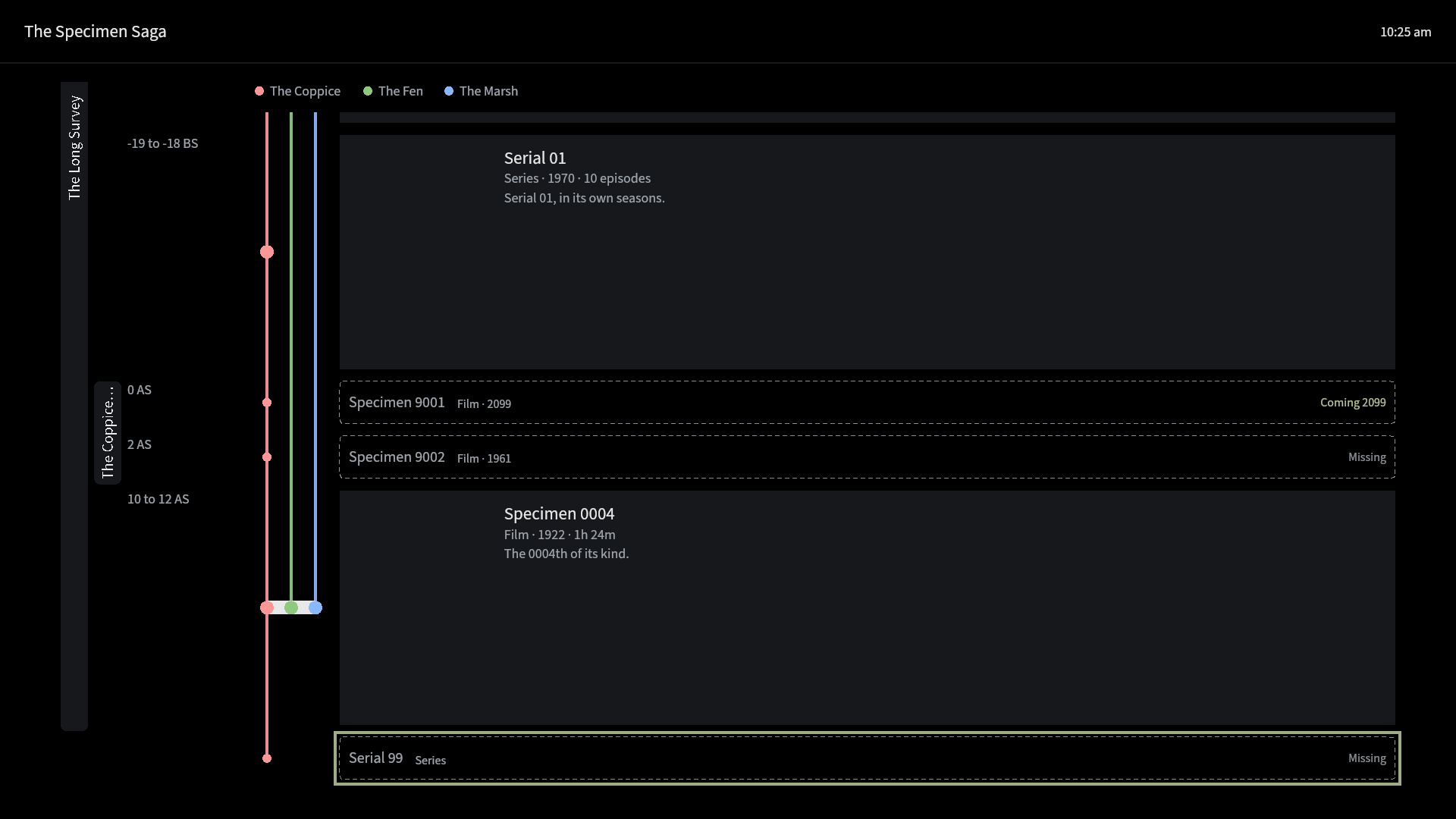
I’m especially proud of the franchises system, all of which would have been far
too exhausting to build without AI. While there are well-established sources for
box sets and collections, there is essentially nothing out there for
representing the narrative story lines of the huge franchises like the MCU or
The Walking Dead. So I had Fable turn a swarm of 20 Sonnets loose on it to
produce https://tangled.org/guid.foo/fiction-franchises to bring this into the
world. I had a few conversations with my daughter about the best way to visually
represent a multiversal timeline in narrative order, and we both agreed that
this was a completely unsolved problem in all of the apps and streaming services
we use. I made a number of
failed
attempts
that I hated, then realized that I could send Claude Design to go out and make
comps for me. It came up with the brilliant “metro
map”
design which we built out last night.
So to those who are growing anxious about the velocity of the code changes and
trying to keep up with it: don’t forget to zoom out. Maybe you don’t need to
know what the code is doing. Maybe you don’t need to steer the shape of the
classes and functions directly. Maybe you should let AIs sweat those details
like we’ve let compilers sweat the details of turning C into machine code for
many decades now.
I’ve never kept a devlog before, and I’ll try my best to keep this up as
development goes on. I’ve backfilled parts of the journey that I could remember.
I got Claude’s help on some of the sequencing. The truth is that I’ve become a
little obsessed with this project. It’s crowded out other hobby pastimes for
now, but it thoroughly integrates quite a few of my interests at once.
This project will be a long-term pursuit of mine, because it’s currently running
my home systems, and thus I must continue pursuing it. It also keeps paying
back in utility the more I develop it, which is not true of many of my side
projects. It is how I felt about Docket. That has to be a
good sign.
Taking the day to establish this devlog and renew a commitment to daily writing
feels like a further investment in the project’s long-term health as well.
While there’s still more iteration and polish to do on the media-operator, I can
already feel the gravity well of a library browser and management system to
rival the venerable Jellyfin. It’s just obvious this is where I’m heading to
very soon.
There’s also a wildcard detour I could take with Spotify
Soloist
to take a swing at music and supplanting Music Assistant. I’m not
sure which direction is pulling me more strongly. The wonderful thing about
sitting at this vantage point is that I can see so many places to go: whole home
media library and playback, a camera-operator to build a K8s-native NVR
system, or taking a fresh swing at an autonomous agent built directly into the
k3s cluster.
Sometimes, I just don’t know when to quit. I have a pretty solid stack now up
through hardware, and yet my Claude subscription hits the weekly reset and I’ve
got all these Fable credits to burn. So I start thinking about that whole-home
A/V octopus again.
And I really love Kubernetes, by the way, if you couldn’t tell. It’s one of my favorite
pieces of software ever. My top four probably go Linux, Kubernetes, Redis, and
PostgreSQL. Tried and true, battle-tested systems with clean abstractions and
ruthlessly focused on performance and stability. In a lot of ways, liken is
my love letter to Linux and Kubernetes.
After the last week or two, there’s an up-and-comer that’s really got my
attention: mpv. What a system! Plays literally anything, and
you can script the UI with Lua, and you can drive the play over a domain socket.
It’s the perfect foundation for a media system following the Linux and
Kubernetes ethos.
I kept pressing Claude to cough up ideas for how we could extend this hardware
system more broadly. I expressed a whole-home A/V vision, but what I wasn’t
seeing at the time was that we were missing a key layer of abstraction between
liken and a multimedia fever dream.
liken sees hardware the same way that the kernel does, because, well, that’s all
there are, liken and the kernel. The kernel doesn’t see a pair of Bluetooth
headphones, it sees a Bluetooth radio that acts
as a gateway to an alien network of other devices. It doesn’t see a monitor, it
sees a GPU that has two HDMI ports. It doesn’t see audio channels, it sees a
sound card with some PCM sinks. I could easily claim the radios and the GPUs
and the cards, but they weren’t really shaped correctly to just hand to a
workload. A music player doesn’t want a Bluetooth radio, it wants a socket to
stream audio to some speakers.
I noticed a common pattern: userspace services that owned a lower-level liken
device (like a Bluetooth radio), handled the
bluetoothd/bluez user-space side, and then
published back to the cluster resources like a game controller or a Bluetooth
speaker. This pattern played out the same way across
displays, audio, and
bluetooth, so I focused on trying to give them as
common a shape as we could.
The results are pretty cool! The audio-operator and display-operator didn’t even
need any new
CRDs
because they just claimed a liken resource and republished the child devices as
new
ResourceSlices
in-cluster. Bluetooth was an interesting exploration and I learned a lot about
Bluetooth pairing and protocol negotiation.
I think the real joy came when I realized we could have the bluetooth-operator
and audio-operator collaborate on exposing things like Bluetooth speakers and
headsets. We still don’t have microphones implemented yet (even now in late
August) but the groundwork is definitely all there.
Riding high on the success of the homelab migration, I started thinking about
what my original vision had been for the homelab, years ago, in the 2010s. I’d
pictured a single brain with digital tentacles snaking through the walls and
lighting up every corner of the house as part of one expanded digital brain.
I’d realized much of this with Home Assistant,
for sure, and Google Home let us pretend we owned a
whole home brain and voice. But there was still something very dull about how
the homelab had landed as a rack of computers tucked in a corner, with everyone
relying on Google TV dongles and speakers rather than talking with our actual
house. Now I had a vocabulary to express that whole house vision, liken with
follower nodes of any size, exposing hardware devices over
DRA
for special cases.
The first target for me was our zigbee2mqtt and
NUT devices on those Raspberry Pi
2s. With a couple
of very low-end mini PCs, they joined as the first non-leader nodes and the
Kubernetes DRA system lets me express exactly why the workloads land on the same
machines that the UPS and Zigbee radios are attached to.
That entire operation took less than a couple hours, and I realized that there
was really no going back.
Due to the sheer humor of the universe, nuc2 (a venerable old beast of 6
years) suffered a power supply failure of some sort, just one week after we
rolled the fleet to liken. I ordered a new mini PC to take its place.
The cluster carried on with four machines while the replacement shipped. nuc2’s
Machine record read Lost, its
scrape targets came out, and the CI runner fleet dropped from five to four.
The replacement, a little Bmax, arrived two days later. Replacing a leader was:
boot the stick, read the hardware report, write the new nuc2 manifest, and
install it as nuc2. It rejoined the leader rotation the same afternoon. From a
dead power supply to a fully replaced leader in two days, and most of that was
shipping.
Over the week leading up to the homelab cutover, I spent a good bit of time
moving anything that wasn’t bolted down into Kubernetes. It wasn’t that much,
just WireGuard (for my homelab’s bootleg Tailscale wannabe system), DNS, NTP,
and some metrics things.
I also happened to have a spare mini PC from my days tinkering with an
autonomous agent. Yes, I ran openclaw for a week. Yes I bought a dedicated
machine for it. Yes I thought I’d build an alternative
myself. No I don’t still run any of
them today. That mini PC was just begging for a workload, and it became
liken-1, the first official physical machine that ever booted to liken. It
has still only booted from the USB stick image once, and has only taken liken’s
“over-the-air” updates since then.
I resolved that I’d just rebuild the whole fleet on liken.
And I did! By about 11pm that night, the whole thing was done and everything was
completely smooth sailing.
And it was…anticlimactic!
LOL nope that’s a total lie. Somewhere in the 7pm hour that evening, when I
imaged the first node, it woke up, decided that it owned flux, saw that I had
turned the flux addon off on purpose, and proceeded to tear down flux on my
entire homelab cluster. This included all the PVs for all the shared files and
databases. I panicked and raced to power off that first node but the damage was
done. I was heartbroken, assuming I’d be restoring things from backups for hours
to come.
Claude, though, Claude said something like, “This is why I took a backup of the
cluster’s etcd database before we started”. You did WHAT?
Yep, Claude had quietly taken a snapshot of etcd and put it on my laptop for
safe-keeping before we took down the first node. That etcd snapshot had all
of the Flux objects and PVCs and PV definitions wiring everything to the right
places on our NAS. Claude restored the backup with some cluster surgery, then
did a rolling restart and at some point said something like “Okay, now go put
the stick in the next machine and hit wipe and reinstall as nuc4. I’ll
wait.”
What a champ, and I really wish I still had the transcript from that evening. We
really didn’t skip a beat and we really did get done with the full rollout by
like 11pm, and I slept like a baby.
After a crazy week of hacking, my conviction really started to sharpen that I
had something really interesting on my hands. It was the server Linux
distribution I’d always wanted: Kubernetes. We’d made something that I wanted,
so it might be something someone else wanted too.
I was still in a mode where I was laser-focused on replacing the distro of my
homelab, but I took a beat to make sure the project was real. I made a GitHub
org, I gave it a website. I even started the first version of that website
on a little 1GB Linode.
Needless to say, I’ve since rethought that deployment architecture. At the time
I felt that I should have at least one place to dogfood it for “real”. A cloud
provider instance did serve well as a real persistent deployment, but the true
endgame was always physical hardware, which would take another couple of weeks.
Heading into a 10-day stretch of relaxation and lake time, I started thinking
about catching up on some maintenance on my homelab. My homelab has never been
in better shape since the advent of AI coding agents. It has fully automated
image updates with flux; the machines themselves were
fairly well-maintained with Ansible. It was a
shining beacon of Infrastructure-as-Code (perhaps even too much, given some
serious circularity in the fact that my internal
gitea instance runs on the same cluster it manages,
but alas).
But not everything smelled like fresh cut grass here. The five mini PCs backing
the k3s cluster were all running Ubuntu
22.04 and had a gajillion pending updates
requiring reboots. I was 4 minor versions behind on k3s. My
zigbee and
UPS controllers
were running on Raspberry Pi
2s (yes, 2s) and
were literally still running Raspbian, which hasn’t
even existed since
2020.
I was drowning in updates, and there’s really no good time to take the cluster
down to apply them.
I started thinking very hard about why I even had Ubuntu and Raspbian in the mix
at all. Just about everything was already running in
K8s, except a few oddballs, like
WireGuard and bind9
for DNS. Surely any service that can run on a host OS can also run under K8s,
right? Why do I even need SSH on these machines? Can’t I just boot straight from
Linux to k3s?
It turns out that, yes, yes we can.
Almost.
So the gears start turning: k3s probably doesn’t actually expect itself to be
pid 1 and it would be
thoroughly unreasonable for Rancher to give it
support for that. So maybe we’d just need a tiny little
init
shim. How does Linux even actually boot up anyway? And how on earth would we
give a pod access to a device like a GPU or a zigbee dongle if there’s no
udev
running? Do there need to be users? What does systemd
actually do?
So I started pulling threads to see what I could learn here. And it didn’t take
long before Claude and I had a very small
proof-of-concept booting
up
on QEMU. I’m not even sure when I could first run
kubectl against
it,
but from that moment, I knew for sure I was going to take this to its logical
conclusion.
(And yes, I did still spend plenty of time with my family by the lake!)